

| Below you will find Study Guides and Reviews of Edgeware Educational Touring productions. |
Edgeware Productions
Study Guides
Study Guides
 |  |  |  |  |  |  |  |

Synopsis of Othello
The play opens with Roderigo, a rich and foolish gentleman, complaining to Iago, a high-ranking soldier, that Iago hadn't told
him about the marriage between Desdemona, a senator's daughter, and Othello, general of the Venetian army. He is upset at
the development because he loves Desdemona and has previously asked her father for her hand in marriage. Iago is upset at
Othello for promoting Cassio above him and tells Roderigo that he is simply using Othello for his own advantage. Iago's
argument against Cassio is that he is a scholarly tactician and has no real battle experience that he can draw from. By
emphasizing this point, and his dissatisfaction with serving under Othello, Iago convinces Roderigo to wake Brabantio and tell
him about his daughter's marriage. After Roderigo rouses Brabantio, Iago makes an aside that he has heard rumors that
Othello has had an affair with his wife. This acts as the second explicit motive for Iago's actions. Later, Iago tells Othello that he
overheard Roderigo telling Brabantio about the marriage and that he (Iago) was angry because the development was meant to
be secret. This is the first instance we see Iago blatantly lie within the text.News arrives in the Senate that the Turks have
attacked Cyprus and Othello is summoned to advise.
Brabantio arrives and accuses Othello of seducing Desdemona by witchcraft, but Othello defends himself successfully before
an assembled Senate.By order of the Duke, Othello leaves Venice to command the Venetian armies against invading Turks on
the island of Cyprus, accompanied by his new wife, his new lieutenant Cassio, his ensign Iago and Emilia, Iago's wife. When
they arrive, they find that a storm has destroyed the Turkish fleet.Iago, who secretly resents Othello for favoring Cassio, takes
the opportunity of Othello being away from home to manipulate his superiors and make Othello jealous of his wife. He
persuades Roderigo to engage Cassio in a fight, before which he gets Cassio drunk. When Othello discovers Cassio drunk
and in a fight, he strips him of his ranks, and confers them upon Iago, which in turn strips Iago of his two stated reasons to
exact revenge on Othello. After Cassio sobers up a bit, Iago persuades Cassio to try Desdemona as an intermediary on
Othello. It is of some note that throughout the text Iago is referred to as "good", and "honest".Iago now works on Othello to make
him suspicious of Desdemona and Cassio. Desdemona drops a handkerchief that was Othello's first gift to her, and Emilia
obtains this for Iago, who has asked her to steal it, having decided to plant it in Cassio's lodgings as evidence of Cassio and
Desdemona's affair.
Emilia is unaware of what Iago plans to do with the handkerchief. After he has planted the handkerchief, Iago tells Othello to
hide, and goads Cassio on to talk about his affair with his mistress Bianca, but since Bianca's name is not mentioned Othello
thinks that Cassio refers to Desdemona. Enraged, he decides to kill his wife and orders Iago to kill Cassio. Iago convinces a
sexually-frustrated Roderigo to kill Cassio because Cassio has just been appointed in Othello's place and, if Cassio lives to
take office, Othello and Desdemona will leave Cyprus, thwarting Roderigo's plans to win Desdemona. Roderigo attacks Cassio
in the street after Cassio leaves Bianca's lodgings and they fight. Both are wounded. Passers-by arrive to help and Iago joins
them, pretending to help Cassio. Iago secretly stabs Roderigo to stop him talking and accuses Bianca of conspiracy to kill
Cassio. In the night, Othello confronts and then smothers Desdemona in bed out of intense jealousy, before Iago's wife, Emilia,
arrives. At Emilia's distress Othello tries to explain himself, justifying his actions by way of her affair, citing the handkerchief
(distinctively embroidered) as proof. Emilia realizes what Iago has done, and she reveals Desdemona's "affair" was Iago's
invention, and Iago is anything but honest. Determined to get Othello arrested for murdering Desdemona, Emilia calls for the
guard. They arrive, and Emilia begins to explain the situation. Iago kills Emilia; Othello, realizing he has been toyed with, attacks
Iago but is disarmed. Lodovico, a Venetian nobleman, apprehends both Iago and Othello, but Othello commits suicide with a
dagger before they could escort him. At the end, it can be assumed, Iago is taken off to be tortured and possibly executed.
The play opens with Roderigo, a rich and foolish gentleman, complaining to Iago, a high-ranking soldier, that Iago hadn't told
him about the marriage between Desdemona, a senator's daughter, and Othello, general of the Venetian army. He is upset at
the development because he loves Desdemona and has previously asked her father for her hand in marriage. Iago is upset at
Othello for promoting Cassio above him and tells Roderigo that he is simply using Othello for his own advantage. Iago's
argument against Cassio is that he is a scholarly tactician and has no real battle experience that he can draw from. By
emphasizing this point, and his dissatisfaction with serving under Othello, Iago convinces Roderigo to wake Brabantio and tell
him about his daughter's marriage. After Roderigo rouses Brabantio, Iago makes an aside that he has heard rumors that
Othello has had an affair with his wife. This acts as the second explicit motive for Iago's actions. Later, Iago tells Othello that he
overheard Roderigo telling Brabantio about the marriage and that he (Iago) was angry because the development was meant to
be secret. This is the first instance we see Iago blatantly lie within the text.News arrives in the Senate that the Turks have
attacked Cyprus and Othello is summoned to advise.
Brabantio arrives and accuses Othello of seducing Desdemona by witchcraft, but Othello defends himself successfully before
an assembled Senate.By order of the Duke, Othello leaves Venice to command the Venetian armies against invading Turks on
the island of Cyprus, accompanied by his new wife, his new lieutenant Cassio, his ensign Iago and Emilia, Iago's wife. When
they arrive, they find that a storm has destroyed the Turkish fleet.Iago, who secretly resents Othello for favoring Cassio, takes
the opportunity of Othello being away from home to manipulate his superiors and make Othello jealous of his wife. He
persuades Roderigo to engage Cassio in a fight, before which he gets Cassio drunk. When Othello discovers Cassio drunk
and in a fight, he strips him of his ranks, and confers them upon Iago, which in turn strips Iago of his two stated reasons to
exact revenge on Othello. After Cassio sobers up a bit, Iago persuades Cassio to try Desdemona as an intermediary on
Othello. It is of some note that throughout the text Iago is referred to as "good", and "honest".Iago now works on Othello to make
him suspicious of Desdemona and Cassio. Desdemona drops a handkerchief that was Othello's first gift to her, and Emilia
obtains this for Iago, who has asked her to steal it, having decided to plant it in Cassio's lodgings as evidence of Cassio and
Desdemona's affair.
Emilia is unaware of what Iago plans to do with the handkerchief. After he has planted the handkerchief, Iago tells Othello to
hide, and goads Cassio on to talk about his affair with his mistress Bianca, but since Bianca's name is not mentioned Othello
thinks that Cassio refers to Desdemona. Enraged, he decides to kill his wife and orders Iago to kill Cassio. Iago convinces a
sexually-frustrated Roderigo to kill Cassio because Cassio has just been appointed in Othello's place and, if Cassio lives to
take office, Othello and Desdemona will leave Cyprus, thwarting Roderigo's plans to win Desdemona. Roderigo attacks Cassio
in the street after Cassio leaves Bianca's lodgings and they fight. Both are wounded. Passers-by arrive to help and Iago joins
them, pretending to help Cassio. Iago secretly stabs Roderigo to stop him talking and accuses Bianca of conspiracy to kill
Cassio. In the night, Othello confronts and then smothers Desdemona in bed out of intense jealousy, before Iago's wife, Emilia,
arrives. At Emilia's distress Othello tries to explain himself, justifying his actions by way of her affair, citing the handkerchief
(distinctively embroidered) as proof. Emilia realizes what Iago has done, and she reveals Desdemona's "affair" was Iago's
invention, and Iago is anything but honest. Determined to get Othello arrested for murdering Desdemona, Emilia calls for the
guard. They arrive, and Emilia begins to explain the situation. Iago kills Emilia; Othello, realizing he has been toyed with, attacks
Iago but is disarmed. Lodovico, a Venetian nobleman, apprehends both Iago and Othello, but Othello commits suicide with a
dagger before they could escort him. At the end, it can be assumed, Iago is taken off to be tortured and possibly executed.

Shakespeare's Biography
For all his fame and celebration, William Shakespeare remains a mysterious figure with regards to personal history. There are
just two primary sources for information on the Bard: his works, and various legal and church documents that have survived from
Elizabethan times. Naturally, there are many gaps in this body of information, which tells us little about Shakespeare the man.
William Shakespeare was born in Stratford-upon-Avon, allegedly on April 23, 1564. Church records from Holy Trinity Church
indicate that he was baptized there on April 26, 1564. Young William was born of John Shakespeare, a glover and leather
merchant, and Mary Arden, a landed local heiress. William, according to the church register, was the third of eight children in the
Shakespeare household—three of whom died in childhood. John Shakespeare had a remarkable run of success as a
merchant, alderman, and high bailiff of Stratford, during William's early childhood. His fortunes declined, however, in the late
1570s.
There is great conjecture about Shakespeare's childhood years, especially regarding his education. It is surmised by scholars
that Shakespeare attended the free grammar school in Stratford, which at the time had a reputation to rival that of Eton. While
there are no records extant to prove this claim, Shakespeare's knowledge of Latin and Classical Greek would tend to support
this theory. In addition, Shakespeare's first biographer, Nicholas Rowe, wrote that John Shakespeare had placed William "for
some time in a free school." John Shakespeare, as a Stratford official, would have been granted a waiver of tuition for his son. As
the records do not exist, we do not know how long William attended the school, but certainly the literary quality of his works
suggest a solid education. What is certain is that William Shakespeare never proceeded to university schooling, which has
stirred some of the debate concerning the authorship of his works.
The next documented event in Shakespeare's life is his marriage to Anne Hathaway on November 28, 1582. William was 18 at
the time, and Anne was 26—and pregnant. Their first daughter, Susanna, was born on May 26, 1583. The couple later had twins,
Hamnet and Judith, born February 2, 1585 and christened at Holy Trinity. Hamnet died in childhood at the age of 11, on August
11, 1596.
For the seven years following the birth of his twins, William Shakespeare disappears from all records, finally turning up again in
London some time in 1592. This period, known as the "Lost Years," has sparked as much controversy about Shakespeare's life
as any period. Rowe notes that young Shakespeare was quite fond of poaching, and may have had to flee Stratford after an
incident with Sir Thomas Lucy, whose deer and rabbits he allegedly poached. There is also rumor of Shakespeare working as
an assistant schoolmaster in Lancashire for a time, though this is circumstantial at best.
It is estimated that Shakespeare arrived in London around 1588 and began to establish himself as an actor and playwright.
Evidently, Shakespeare garnered envy early on for his talent, as related by the critical attack of Robert Greene, a London
playwright, in 1592: "...an upstart crow, beautified with our feathers, that with his Tiger's heart wrapped in a player's hide,
supposes he is as well able to bombast out a blank verse as the best of you: and being an absolute Johannes fac totum, is in
his own conceit the only Shake-scene in a country."
Greene's bombast notwithstanding, Shakespeare must have shown considerable promise. By 1594, he was not only acting and
writing for the Lord Chamberlain's Men (called the King's Men after the ascension of James I in 1603), but was a managing
partner in the operation as well. With Will Kempe, a master comedian, and Richard Burbage, a leading tragic actor of the day, the
Lord Chamberlain's Men became a favorite London troupe, patronized by royalty and made popular by the theatre-going public.
Shakespeare's success is apparent when studied against other playwrights of this age. His company was the most successful
in London in his day. He had plays published and sold in octavo editions, or "penny-copies" to the more literate of his audiences.
Never before had a playwright enjoyed sufficient acclaim to see his works published and sold as popular literature in the midst
of his career. In addition, Shakespeare's ownership share in both the theatrical company and the Globe itself made him as
much an entrepeneur as artist. While Shakespeare might not be accounted wealthy by London standards, his success allowed
him to purchase New House and retire in comfort to Stratford in 1611.
William Shakespeare wrote his will in 1611, bequeathing his properties to his daughter Susanna (married in 1607 to Dr. John
Hall). To his surviving daughter Judith, he left £300, and to his wife Anne left "my second best bed." William Shakespeare
allegedly died on his birthday, April 23, 1616. This is probably more of a romantic myth than reality, but Shakespeare was
interred at Holy Trinity in Stratford on April 25. In 1623, two working companions of Shakespeare from the Lord Chamberlain's
Men, John Heminges and Henry Condell, printed the First Folio edition of his collected plays, of which half were previously
unpublished.
William Shakespeare's legacy is a body of work that will never again be equaled in Western civilization. His words have endured
for 400 years, and still reach across the centuries as powerfully as ever.
For all his fame and celebration, William Shakespeare remains a mysterious figure with regards to personal history. There are
just two primary sources for information on the Bard: his works, and various legal and church documents that have survived from
Elizabethan times. Naturally, there are many gaps in this body of information, which tells us little about Shakespeare the man.
William Shakespeare was born in Stratford-upon-Avon, allegedly on April 23, 1564. Church records from Holy Trinity Church
indicate that he was baptized there on April 26, 1564. Young William was born of John Shakespeare, a glover and leather
merchant, and Mary Arden, a landed local heiress. William, according to the church register, was the third of eight children in the
Shakespeare household—three of whom died in childhood. John Shakespeare had a remarkable run of success as a
merchant, alderman, and high bailiff of Stratford, during William's early childhood. His fortunes declined, however, in the late
1570s.
There is great conjecture about Shakespeare's childhood years, especially regarding his education. It is surmised by scholars
that Shakespeare attended the free grammar school in Stratford, which at the time had a reputation to rival that of Eton. While
there are no records extant to prove this claim, Shakespeare's knowledge of Latin and Classical Greek would tend to support
this theory. In addition, Shakespeare's first biographer, Nicholas Rowe, wrote that John Shakespeare had placed William "for
some time in a free school." John Shakespeare, as a Stratford official, would have been granted a waiver of tuition for his son. As
the records do not exist, we do not know how long William attended the school, but certainly the literary quality of his works
suggest a solid education. What is certain is that William Shakespeare never proceeded to university schooling, which has
stirred some of the debate concerning the authorship of his works.
The next documented event in Shakespeare's life is his marriage to Anne Hathaway on November 28, 1582. William was 18 at
the time, and Anne was 26—and pregnant. Their first daughter, Susanna, was born on May 26, 1583. The couple later had twins,
Hamnet and Judith, born February 2, 1585 and christened at Holy Trinity. Hamnet died in childhood at the age of 11, on August
11, 1596.
For the seven years following the birth of his twins, William Shakespeare disappears from all records, finally turning up again in
London some time in 1592. This period, known as the "Lost Years," has sparked as much controversy about Shakespeare's life
as any period. Rowe notes that young Shakespeare was quite fond of poaching, and may have had to flee Stratford after an
incident with Sir Thomas Lucy, whose deer and rabbits he allegedly poached. There is also rumor of Shakespeare working as
an assistant schoolmaster in Lancashire for a time, though this is circumstantial at best.
It is estimated that Shakespeare arrived in London around 1588 and began to establish himself as an actor and playwright.
Evidently, Shakespeare garnered envy early on for his talent, as related by the critical attack of Robert Greene, a London
playwright, in 1592: "...an upstart crow, beautified with our feathers, that with his Tiger's heart wrapped in a player's hide,
supposes he is as well able to bombast out a blank verse as the best of you: and being an absolute Johannes fac totum, is in
his own conceit the only Shake-scene in a country."
Greene's bombast notwithstanding, Shakespeare must have shown considerable promise. By 1594, he was not only acting and
writing for the Lord Chamberlain's Men (called the King's Men after the ascension of James I in 1603), but was a managing
partner in the operation as well. With Will Kempe, a master comedian, and Richard Burbage, a leading tragic actor of the day, the
Lord Chamberlain's Men became a favorite London troupe, patronized by royalty and made popular by the theatre-going public.
Shakespeare's success is apparent when studied against other playwrights of this age. His company was the most successful
in London in his day. He had plays published and sold in octavo editions, or "penny-copies" to the more literate of his audiences.
Never before had a playwright enjoyed sufficient acclaim to see his works published and sold as popular literature in the midst
of his career. In addition, Shakespeare's ownership share in both the theatrical company and the Globe itself made him as
much an entrepeneur as artist. While Shakespeare might not be accounted wealthy by London standards, his success allowed
him to purchase New House and retire in comfort to Stratford in 1611.
William Shakespeare wrote his will in 1611, bequeathing his properties to his daughter Susanna (married in 1607 to Dr. John
Hall). To his surviving daughter Judith, he left £300, and to his wife Anne left "my second best bed." William Shakespeare
allegedly died on his birthday, April 23, 1616. This is probably more of a romantic myth than reality, but Shakespeare was
interred at Holy Trinity in Stratford on April 25. In 1623, two working companions of Shakespeare from the Lord Chamberlain's
Men, John Heminges and Henry Condell, printed the First Folio edition of his collected plays, of which half were previously
unpublished.
William Shakespeare's legacy is a body of work that will never again be equaled in Western civilization. His words have endured
for 400 years, and still reach across the centuries as powerfully as ever.
| William Shakespeare (1564-1616) Actor, Poet, Playwright and Theatre Owner |
| Reconstruction of the Globe Theatre |
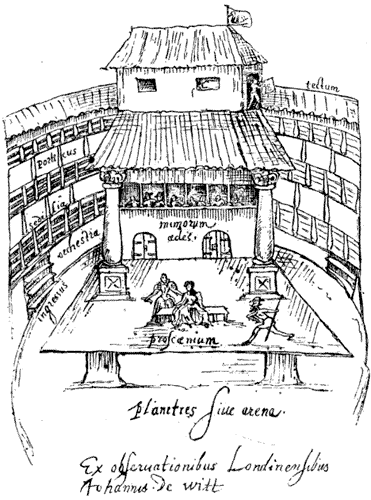
| Sketch of the Swan Theatre by a Contemporary of Shakespeare |
Shakespeare's Plays
Shakespeare's plays form one of literature's
greatest legacies. Divided into comedies,
histories and tragedies, Shakespeare plays
have spawned thousands of performances,
adaptations and films. From famous
tragedies like Macbeth and King Lear to
tragic love stories such as Romeo and Juliet
to epic historic plays like Antony and
Cleopatra, enlighten, sadden, teach and
most important of all, entertain.
Comedies Histories Tragedies
All's Well That Ends Well
As You Like It
The Comedy of Errors
Cymbeline
Love's Labours Lost
Measure for Measure
The Merry Wives of Windsor
The Merchant of Venice
A Midsummer Night's Dream
Much Ado About Nothing
Pericles, Prince of Tyre
Taming of the Shrew
The Tempest
Troilus and Cressida
Twelfth Night
Two Gentlemen of Verona
Winter's Tale Henry IV, Part I
Henry IV, Part II
Henry V
Henry VI, Part I
Henry VI, Part II
Henry VI, Part III
Henry VIII
King John
Richard II
Richard III Antony and Cleopatra
Coriolanus
Hamlet
Julius Caesar
King Lear
Macbeth
Othello
Romeo and Juliet
Timon of Athens
Titus Andronicus
Shakespeare's plays form one of literature's
greatest legacies. Divided into comedies,
histories and tragedies, Shakespeare plays
have spawned thousands of performances,
adaptations and films. From famous
tragedies like Macbeth and King Lear to
tragic love stories such as Romeo and Juliet
to epic historic plays like Antony and
Cleopatra, enlighten, sadden, teach and
most important of all, entertain.
Comedies Histories Tragedies
All's Well That Ends Well
As You Like It
The Comedy of Errors
Cymbeline
Love's Labours Lost
Measure for Measure
The Merry Wives of Windsor
The Merchant of Venice
A Midsummer Night's Dream
Much Ado About Nothing
Pericles, Prince of Tyre
Taming of the Shrew
The Tempest
Troilus and Cressida
Twelfth Night
Two Gentlemen of Verona
Winter's Tale Henry IV, Part I
Henry IV, Part II
Henry V
Henry VI, Part I
Henry VI, Part II
Henry VI, Part III
Henry VIII
King John
Richard II
Richard III Antony and Cleopatra
Coriolanus
Hamlet
Julius Caesar
King Lear
Macbeth
Othello
Romeo and Juliet
Timon of Athens
Titus Andronicus
Questions for Discussion
1. Why did Iago cruelly deceive Othello? List and discuss the reasons
for Iago's plot.
2. Do you think that Desdemona's innocence contributes to her fate.
Why does she stay with Othello after he starts to abuse her? What would you
do if something like this happened to you?
3. This play is about the racism of an entire community. How does
Shakespeare show that racism is one of the key factors in the outcome of
this tragedy?
4. What do you think of the treatment of the other women in this play?
Why does Emilia help Iago by giving him the handkerchief. What do you
think of Cassio's treatment of Bianca?
5. Do you have any sympathy for the foolish Roderigo? What motivates
him to be a conspirator? Why does Iago murder him?
6. What are the reasons that Othello falls for Iago's story of Desdmona's
infidelity? Is he foolish or gullible?
7. Discuss the relationship between Emilia and Iago. Were they ever in
love? Why does Iago kill her?
8. Do you think the Alaska/Russian theme of this production contributes
or detracts from the play?
9. Describe the characters as presented in this play. Which
performances did you like?
1. Why did Iago cruelly deceive Othello? List and discuss the reasons
for Iago's plot.
2. Do you think that Desdemona's innocence contributes to her fate.
Why does she stay with Othello after he starts to abuse her? What would you
do if something like this happened to you?
3. This play is about the racism of an entire community. How does
Shakespeare show that racism is one of the key factors in the outcome of
this tragedy?
4. What do you think of the treatment of the other women in this play?
Why does Emilia help Iago by giving him the handkerchief. What do you
think of Cassio's treatment of Bianca?
5. Do you have any sympathy for the foolish Roderigo? What motivates
him to be a conspirator? Why does Iago murder him?
6. What are the reasons that Othello falls for Iago's story of Desdmona's
infidelity? Is he foolish or gullible?
7. Discuss the relationship between Emilia and Iago. Were they ever in
love? Why does Iago kill her?
8. Do you think the Alaska/Russian theme of this production contributes
or detracts from the play?
9. Describe the characters as presented in this play. Which
performances did you like?

Painting of a production of Othello
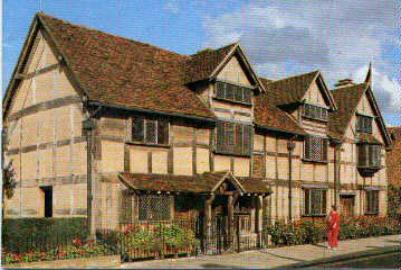
| Shakespeare Birthplace in Startford-upon-Avon |
Notes on Edgeware's Production of Othello
It was during the run of Hamlet in 2002 that we began discussions about the possibilities of a production of Othello set in
Russian period Alaska. Transplanting the story began to make more and more sense the further we looked into it, the
distance between Venice and Kodiak is not so great as one might imagine. Each city had been a hub of trade and a
meeting place of diverse cultures.
When we began to look at the character of Othello in particular, it made complete sense that he should be Aleut. Lines
such as "being taken by the insolent foe, and sold to slavery" rang true to Aleut experience. We chose the mid 19th
century for the time period, an era near the end of Russian rule and the transition to American hands on the horizon. That
Othello should have attained such a high military rank had historical precedence, as Aleuts were given officer positions
in the Russian Imperial Navy. Othello's storied battles could have easily been played out in the Battle of Sitka, in 1802
and 1804, or among many skirmishes along the fur trade routes all the way down the Pacific coast to California and
Mexico. After more than a century of Russian contact, Aleut people had just begun to reach parity with their Russian
occupiers, only to lose those gains and undergoing a second colonization with the transfer of Alaska to American hands.
We found many connections between Alaskan history and the world of Shakespeare's Othello.
Ultimately though, it was not Shakespeare's intent to create an historical drama, but rather a tragedy of complex human
relationships. Shakespeare, gifted as he is in depicting "all qualities with a learned spirit of human dealings" invites us
to look at those human dealings in many settings and time periods. Shakespeare dared us to dream, and now more
than 5 years later that dream has become a reality. The process of transplanting the story has been challenging and
rewarding, we hope that this is the experience for the audience as well.
Allan Hayton, Actor Playing Othello
It was during the run of Hamlet in 2002 that we began discussions about the possibilities of a production of Othello set in
Russian period Alaska. Transplanting the story began to make more and more sense the further we looked into it, the
distance between Venice and Kodiak is not so great as one might imagine. Each city had been a hub of trade and a
meeting place of diverse cultures.
When we began to look at the character of Othello in particular, it made complete sense that he should be Aleut. Lines
such as "being taken by the insolent foe, and sold to slavery" rang true to Aleut experience. We chose the mid 19th
century for the time period, an era near the end of Russian rule and the transition to American hands on the horizon. That
Othello should have attained such a high military rank had historical precedence, as Aleuts were given officer positions
in the Russian Imperial Navy. Othello's storied battles could have easily been played out in the Battle of Sitka, in 1802
and 1804, or among many skirmishes along the fur trade routes all the way down the Pacific coast to California and
Mexico. After more than a century of Russian contact, Aleut people had just begun to reach parity with their Russian
occupiers, only to lose those gains and undergoing a second colonization with the transfer of Alaska to American hands.
We found many connections between Alaskan history and the world of Shakespeare's Othello.
Ultimately though, it was not Shakespeare's intent to create an historical drama, but rather a tragedy of complex human
relationships. Shakespeare, gifted as he is in depicting "all qualities with a learned spirit of human dealings" invites us
to look at those human dealings in many settings and time periods. Shakespeare dared us to dream, and now more
than 5 years later that dream has become a reality. The process of transplanting the story has been challenging and
rewarding, we hope that this is the experience for the audience as well.
Allan Hayton, Actor Playing Othello
Reviews of Libby
Juneau Empire ©2011
Historical play 'Libby' makes its Juneau debut
Posted: Thursday, February 17, 2011
By AMY CONDRA
In 1879 Libby Beaman boarded the S.S. St. Paul to venture across the Bering Sea toward the Pribilof Islands.
courtesy of Edgeware Productions / courtesy of Edgeware Productions
Her presence there wouldn’t be by accident; Libby had asked President Rutherford B. Hayes, a family friend, for
permission to accompany her husband to what Russian missionaries once called, “the place that God forgot.”
The ship’s captain told the Washington, D.C. socialite that she would be the first non-Native woman to venture to the
remote Pribilofs, where her husband would serve as Assistant to the Senior Revenue Agent. And her husband’s
superior officer told her presence would be, as Libby later recounted in her journal, “the most unwise and foolhardy
thing I’ve ever heard of.”
This week in Juneau, Libby Beaman, as portrayed by actress Elizabeth Ware, will tell audiences what it was like to live
in a land that could be both hostile and hauntingly beautiful. “Libby,” a one-woman play based on Beaman’s diary and
sketchbook, has been performed throughout Alaska and the Lower 48, and has earned a four-star review at the
Edinburgh Fringe Festival in Scotland. This week’s performances at the Juneau Arts & Humanities Council will mark
the first time the play has been staged locally. “It’s about time!” Ware said. “I’m very much looking forward to coming
down and performing for Juneau.”
The Anchorage-based actress has assumed the role of Libby numerous times over the past 13 years. “This is the
story of an adventurous and brave woman,” she said. “She goes into this experience with a colonial attitude, and
comes out with the realization that there are others ways of living life, of living in the world, than the ones she’s used to.”
On St. Paul Island, Libby met the Pribilof Aleuts, who had been brought to the Pribilofs a hundred years earlier by seal
fur traders and had, under first Russian and later American rule, endured tumultuous upheavals. They had also
developed a unique culture, one that couldn’t help but influence Libby’s impressions of life on the island. “She was
drawn into the life and people there, into their community and values,” Ware said.
The director of the play, David Edgecombe, holds a Ph.D. in theater history and directing from Kent State University and
is a professor at the University of Alaska Anchorage’s Department of Theatre and Dance. Ware says that she and
Edgecombe first learned of Libby’s story in 1992, when they were working with a theater company in Vladivostok,
Russia. “My mother was planning to come over and asked us what we wanted, and we said, ‘Peanut butter and books
in English, please!’” Ware said. One of the books her mother brought was “Libby: The Alaskan Diaries and Letters of
Libby Beaman, 1879-1880,” published in 1987 by Libby’s granddaughter, Betty John. “The story was fascinating, and I
had a sense of it as a one-woman show,” Edgecombe said.
He started adapting the book for the stage in 1997, in response to a request for a play that would commemorate
Women’s History Month by celebrating Alaska’s pioneering women. “Libby” was first performed at Cyrano’s Off-Center
Playhouse in Anchorage. But it is a performance on St. Paul Island, where Libby wrote her journals and drew in her
sketchbook, which offered Edgecombe a rare insight into the play’s setting.
“Liz performed in a community center, and in the distance you could hear barking seals, right when she was talking
about the seals!” Edgecombe recalled. “The experience was thrilling to say the least,” Ware said. “Just to be able to go
to St. Paul — I still get goose bumps! When we drove up to the place where we were staying, we found it was near one
of the seal rookeries. And the only way to describe the sound was as a cacophony. I was brought up in the southwest
on a ranch, and the barking of the seals sounds just like cattle — herds and herds of cattle, going nonstop!”
The play’s Juneau performances are being sponsored by the Friends of the Alaska State Museum, and the
organization’s vice president, Renee Hughes, said a museum exhibit prompted her desire to bring “Libby” to town.
“Recently the State Museums hosted a traveling exhibit on the Pribilof Islands and the fur sealing industry. This
brought back memories of reading the book ‘Libby,’ and then seeing Elizabeth Ware’s performance in Anchorage,”
she said. “We discovered that she was still doing the performance and would enjoy bringing the story to the
Southeast.” “The Alaska State Museum is charged with being the stewards of all of Alaska’s history,” added Hughes,
“and this is an opportunity for the Friends to showcase a small part of it.”
“LIBBY—AN ALASKAN DIARY” IS A PLEASURE
March 20, 1998
By LOIS WILLOW
Daily News theater reviewer
At last, a play worth waiting for. An intelligent, interesting, history-based drama about the beauty and harshness of
Alaska, about women and daring that takes us pleasurably for a few hours to another world and time.
“Libby — An Alaskan Diary” opened at Cyrano’s on Thursday. Elizabeth Ware plays Libby Beaman in this solo
performance of a woman’s journey to adventure, the story of a real woman who came with her husband to Alaska’s
remote Pribilof Islands in 1879. Director David Edgecombe led this excellent stage adaptation from the book compiled
from Beaman’s diary, letters and verbal history. Libby was a woman who combined the soul of a scientist with that of
an artist. Her descriptions of people, flora, fauna and weather give the feeling of being there, with language like “clouds
of pale blue butterflies,” “dunes pink in the rain” and the “boom and wash of the waves.”
The play is an emotionally rich portrayal of her isolation, her affinity with the Aleut head woman, the feeling of being
unwanted, the sexual tension of the seal mating season. The audience heartily enjoyed the frequent humor that
lightened the story of often dangerous and grim circumstances.
Ware performed extremely well. Aside from a few minor first-night hesitations, she drew us into the main character,
assumed the roles of others and conjured different scenes — a ship or a cliff edge — for the audience to “see. Libby
challenged the limits we all put on ourselves. She stepped around the accepted 19th century perceptions of
“Ladies don’t . . .” She was a lady who did. And she accepted the responsibility for her choices.
As she sailed from the island, she described the misty silhouette as it “falls over the edge of the world and we are all
alone on the vast ocean; between ports, and between the chapters of our lives.” We learn to dare to ask more of life as
she says, “I’m going on, not back, but on into the vast unknown.”
The audience gave a standing ovation and most stayed for a panel discussion of the book’s historical accuracy or
inaccuracy and the way Libby communicated the heart of her experience. One panelist, Larry Merculieff, former mayor
of the Pribilof town of St. Paul, said, “The way she describes the island is exactly the way I feel about it. (Henry Wood)
Elliot (a prominent expert who listed facts) never did that.” Ware and Edgecombe’s show is a play to learn from and
laugh with, capturing a dangerous place and time in the everyday clothes of a woman’s story.
LIBBY AT THE GARAGE THEATRE IN EDINBURGH, SCOTLAND
FOUR STARS
August 20, 1999
By Diane Dubois
This accessible and compelling story would make a fine feature film. Based on the 1879 journals of Elizabeth
Beaman, the play tells the tale of a feisty, funny woman who was as much a pioneer on the frontier of women’s
freedom as on the frozen wastes of Alaska.
The audience is seated on 20 or so seats around the edges of a night club dance floor. Using minimal sets, props,
lighting and sound, the beauty, brutality and horror of Alaska are evoked. We gain a fascinating insight into this remote
part of the world through a combination of good acting and a script that uses clever, vivid and amusing similes.
This one-woman show is skillfully performed by Elizabeth Ware, who is a compelling storyteller. Libby is a society lady,
but she is also tough, as her adventures demonstrate. She constantly wants more from life, defying the pig-headed
males who find her demands absurd. No matter how many times she is told that “young ladies do not do that”, she
just carries on regardless.
Do not expect a po-faced feminist diatribe. This play is a compassionate and incisive exploration of the limitations
placed on women. The script never rants but does its job with small, telling details and frank outbursts. You cannot
help but feel that you are meeting a fascinating woman who does not fully realize how brilliant she is.
Diane Dubois
Until 20 August
WARE DOESN’T JUST READ ALASKA HISTORY—SHE LIVES IT!
June 2002
By CATHERINE STADEM
Daily News theater reviewer
• LIBBY: Actress becomes Elizabeth Beaman and makes audiences feel they’re visiting the Pribilofs.
Elizabeth Ware has become “Libby” after performing the one-woman show countless times in Alaska, the United
Kingdom and across the Lower 48 in the past four years. Ware’s partner in this enterprise, husband David
Edgecombe, wrote the script about the first white woman to live in the Pribilof Islands, based on Libby Beaman’s diary
of 1879-80. It premiered at Cyrano’s Off Center Playhouse in the 1997-98 season, and it’s back for a few
performances this weekend and next week.
Unlike many stage adaptations from extant texts, “Libby” is not static. Ware does not stand and read (or sound like she’
s reading) from someone else’s work.
The actor has made the role her own, chatting with the audience across the century as though she had invited
everyone into her parlor for 80 minutes of tea and genteel conversation. Laced up tight in a corset, yet looking at ease
in an authentic Victorian gown, Ware as Libby relates the fascinating story of her youth in Washington~ D.C., her family’
s acquaintance with President Lincoln, the trauma of the Civil War, her meeting with President Hayes and her eventual
marriage to Mr. Beaman, the love of her life.
When her husband is assigned to work on St. Paul Island in the Bering Sea. She insists on accompanying him, much
to the shock of her family and peers and to the chagrin of the crew aboard the ship that takes them from San Francisco
to the Aleutians, past Unalaska to the Pribilofs. Through Edgecombe’s writing and Ware’s delivery, you can’t smell the
thrashing waves and hear the screeching seabirds as the voyage progresses. As the islands — tiny dots in the middle
of a vast ocean — peek through the ever-present fog, this extraordinary woman’s description of the magnificent seal
rookeries is clearer than a photograph.
I’ve seen Ware in this role two or three times over the past few years, and each time her performance becomes richer
and more textured. At Thursday’s opening, despite a runny nose and a few line stumbles, she was completely
convincing. The biggest problem was pacing, which accelerated at the emotional end of the second act, leaving no
transitional pauses between scenes of dark, cold, scurvy-ridden winter and sunny, optimistic spring. This rush of
images weakened the play’s lovely ending.
As an excursion into Alaska’s past, “Libby” is an important contribution to history. As an example of local talent at its
best, the production should make Edgecombe and Ware proud indeed.
Juneau Empire ©2011
Historical play 'Libby' makes its Juneau debut
Posted: Thursday, February 17, 2011
By AMY CONDRA
In 1879 Libby Beaman boarded the S.S. St. Paul to venture across the Bering Sea toward the Pribilof Islands.
courtesy of Edgeware Productions / courtesy of Edgeware Productions
Her presence there wouldn’t be by accident; Libby had asked President Rutherford B. Hayes, a family friend, for
permission to accompany her husband to what Russian missionaries once called, “the place that God forgot.”
The ship’s captain told the Washington, D.C. socialite that she would be the first non-Native woman to venture to the
remote Pribilofs, where her husband would serve as Assistant to the Senior Revenue Agent. And her husband’s
superior officer told her presence would be, as Libby later recounted in her journal, “the most unwise and foolhardy
thing I’ve ever heard of.”
This week in Juneau, Libby Beaman, as portrayed by actress Elizabeth Ware, will tell audiences what it was like to live
in a land that could be both hostile and hauntingly beautiful. “Libby,” a one-woman play based on Beaman’s diary and
sketchbook, has been performed throughout Alaska and the Lower 48, and has earned a four-star review at the
Edinburgh Fringe Festival in Scotland. This week’s performances at the Juneau Arts & Humanities Council will mark
the first time the play has been staged locally. “It’s about time!” Ware said. “I’m very much looking forward to coming
down and performing for Juneau.”
The Anchorage-based actress has assumed the role of Libby numerous times over the past 13 years. “This is the
story of an adventurous and brave woman,” she said. “She goes into this experience with a colonial attitude, and
comes out with the realization that there are others ways of living life, of living in the world, than the ones she’s used to.”
On St. Paul Island, Libby met the Pribilof Aleuts, who had been brought to the Pribilofs a hundred years earlier by seal
fur traders and had, under first Russian and later American rule, endured tumultuous upheavals. They had also
developed a unique culture, one that couldn’t help but influence Libby’s impressions of life on the island. “She was
drawn into the life and people there, into their community and values,” Ware said.
The director of the play, David Edgecombe, holds a Ph.D. in theater history and directing from Kent State University and
is a professor at the University of Alaska Anchorage’s Department of Theatre and Dance. Ware says that she and
Edgecombe first learned of Libby’s story in 1992, when they were working with a theater company in Vladivostok,
Russia. “My mother was planning to come over and asked us what we wanted, and we said, ‘Peanut butter and books
in English, please!’” Ware said. One of the books her mother brought was “Libby: The Alaskan Diaries and Letters of
Libby Beaman, 1879-1880,” published in 1987 by Libby’s granddaughter, Betty John. “The story was fascinating, and I
had a sense of it as a one-woman show,” Edgecombe said.
He started adapting the book for the stage in 1997, in response to a request for a play that would commemorate
Women’s History Month by celebrating Alaska’s pioneering women. “Libby” was first performed at Cyrano’s Off-Center
Playhouse in Anchorage. But it is a performance on St. Paul Island, where Libby wrote her journals and drew in her
sketchbook, which offered Edgecombe a rare insight into the play’s setting.
“Liz performed in a community center, and in the distance you could hear barking seals, right when she was talking
about the seals!” Edgecombe recalled. “The experience was thrilling to say the least,” Ware said. “Just to be able to go
to St. Paul — I still get goose bumps! When we drove up to the place where we were staying, we found it was near one
of the seal rookeries. And the only way to describe the sound was as a cacophony. I was brought up in the southwest
on a ranch, and the barking of the seals sounds just like cattle — herds and herds of cattle, going nonstop!”
The play’s Juneau performances are being sponsored by the Friends of the Alaska State Museum, and the
organization’s vice president, Renee Hughes, said a museum exhibit prompted her desire to bring “Libby” to town.
“Recently the State Museums hosted a traveling exhibit on the Pribilof Islands and the fur sealing industry. This
brought back memories of reading the book ‘Libby,’ and then seeing Elizabeth Ware’s performance in Anchorage,”
she said. “We discovered that she was still doing the performance and would enjoy bringing the story to the
Southeast.” “The Alaska State Museum is charged with being the stewards of all of Alaska’s history,” added Hughes,
“and this is an opportunity for the Friends to showcase a small part of it.”
“LIBBY—AN ALASKAN DIARY” IS A PLEASURE
March 20, 1998
By LOIS WILLOW
Daily News theater reviewer
At last, a play worth waiting for. An intelligent, interesting, history-based drama about the beauty and harshness of
Alaska, about women and daring that takes us pleasurably for a few hours to another world and time.
“Libby — An Alaskan Diary” opened at Cyrano’s on Thursday. Elizabeth Ware plays Libby Beaman in this solo
performance of a woman’s journey to adventure, the story of a real woman who came with her husband to Alaska’s
remote Pribilof Islands in 1879. Director David Edgecombe led this excellent stage adaptation from the book compiled
from Beaman’s diary, letters and verbal history. Libby was a woman who combined the soul of a scientist with that of
an artist. Her descriptions of people, flora, fauna and weather give the feeling of being there, with language like “clouds
of pale blue butterflies,” “dunes pink in the rain” and the “boom and wash of the waves.”
The play is an emotionally rich portrayal of her isolation, her affinity with the Aleut head woman, the feeling of being
unwanted, the sexual tension of the seal mating season. The audience heartily enjoyed the frequent humor that
lightened the story of often dangerous and grim circumstances.
Ware performed extremely well. Aside from a few minor first-night hesitations, she drew us into the main character,
assumed the roles of others and conjured different scenes — a ship or a cliff edge — for the audience to “see. Libby
challenged the limits we all put on ourselves. She stepped around the accepted 19th century perceptions of
“Ladies don’t . . .” She was a lady who did. And she accepted the responsibility for her choices.
As she sailed from the island, she described the misty silhouette as it “falls over the edge of the world and we are all
alone on the vast ocean; between ports, and between the chapters of our lives.” We learn to dare to ask more of life as
she says, “I’m going on, not back, but on into the vast unknown.”
The audience gave a standing ovation and most stayed for a panel discussion of the book’s historical accuracy or
inaccuracy and the way Libby communicated the heart of her experience. One panelist, Larry Merculieff, former mayor
of the Pribilof town of St. Paul, said, “The way she describes the island is exactly the way I feel about it. (Henry Wood)
Elliot (a prominent expert who listed facts) never did that.” Ware and Edgecombe’s show is a play to learn from and
laugh with, capturing a dangerous place and time in the everyday clothes of a woman’s story.
LIBBY AT THE GARAGE THEATRE IN EDINBURGH, SCOTLAND
FOUR STARS
August 20, 1999
By Diane Dubois
This accessible and compelling story would make a fine feature film. Based on the 1879 journals of Elizabeth
Beaman, the play tells the tale of a feisty, funny woman who was as much a pioneer on the frontier of women’s
freedom as on the frozen wastes of Alaska.
The audience is seated on 20 or so seats around the edges of a night club dance floor. Using minimal sets, props,
lighting and sound, the beauty, brutality and horror of Alaska are evoked. We gain a fascinating insight into this remote
part of the world through a combination of good acting and a script that uses clever, vivid and amusing similes.
This one-woman show is skillfully performed by Elizabeth Ware, who is a compelling storyteller. Libby is a society lady,
but she is also tough, as her adventures demonstrate. She constantly wants more from life, defying the pig-headed
males who find her demands absurd. No matter how many times she is told that “young ladies do not do that”, she
just carries on regardless.
Do not expect a po-faced feminist diatribe. This play is a compassionate and incisive exploration of the limitations
placed on women. The script never rants but does its job with small, telling details and frank outbursts. You cannot
help but feel that you are meeting a fascinating woman who does not fully realize how brilliant she is.
Diane Dubois
Until 20 August
WARE DOESN’T JUST READ ALASKA HISTORY—SHE LIVES IT!
June 2002
By CATHERINE STADEM
Daily News theater reviewer
• LIBBY: Actress becomes Elizabeth Beaman and makes audiences feel they’re visiting the Pribilofs.
Elizabeth Ware has become “Libby” after performing the one-woman show countless times in Alaska, the United
Kingdom and across the Lower 48 in the past four years. Ware’s partner in this enterprise, husband David
Edgecombe, wrote the script about the first white woman to live in the Pribilof Islands, based on Libby Beaman’s diary
of 1879-80. It premiered at Cyrano’s Off Center Playhouse in the 1997-98 season, and it’s back for a few
performances this weekend and next week.
Unlike many stage adaptations from extant texts, “Libby” is not static. Ware does not stand and read (or sound like she’
s reading) from someone else’s work.
The actor has made the role her own, chatting with the audience across the century as though she had invited
everyone into her parlor for 80 minutes of tea and genteel conversation. Laced up tight in a corset, yet looking at ease
in an authentic Victorian gown, Ware as Libby relates the fascinating story of her youth in Washington~ D.C., her family’
s acquaintance with President Lincoln, the trauma of the Civil War, her meeting with President Hayes and her eventual
marriage to Mr. Beaman, the love of her life.
When her husband is assigned to work on St. Paul Island in the Bering Sea. She insists on accompanying him, much
to the shock of her family and peers and to the chagrin of the crew aboard the ship that takes them from San Francisco
to the Aleutians, past Unalaska to the Pribilofs. Through Edgecombe’s writing and Ware’s delivery, you can’t smell the
thrashing waves and hear the screeching seabirds as the voyage progresses. As the islands — tiny dots in the middle
of a vast ocean — peek through the ever-present fog, this extraordinary woman’s description of the magnificent seal
rookeries is clearer than a photograph.
I’ve seen Ware in this role two or three times over the past few years, and each time her performance becomes richer
and more textured. At Thursday’s opening, despite a runny nose and a few line stumbles, she was completely
convincing. The biggest problem was pacing, which accelerated at the emotional end of the second act, leaving no
transitional pauses between scenes of dark, cold, scurvy-ridden winter and sunny, optimistic spring. This rush of
images weakened the play’s lovely ending.
As an excursion into Alaska’s past, “Libby” is an important contribution to history. As an example of local talent at its
best, the production should make Edgecombe and Ware proud indeed.